Built for mountain & desert homes
Frozen lines in Jackson and Flagstaff, hard water in St. George, high-altitude heaters in Durango — we know your climate.

Hydronic Radiant Heating
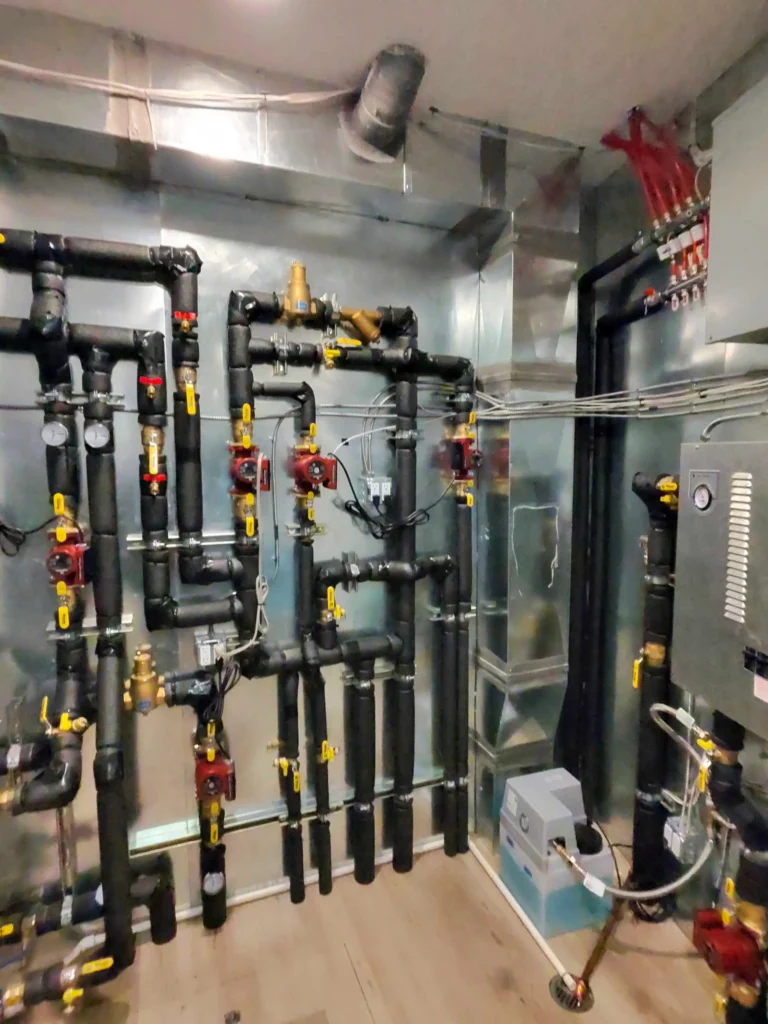
Hydronic heating moves warm water, not air. Tubing under the floor, or fin-tube baseboards along the walls, release heat slowly into the room, so there are no drafts, no vents blowing dust and no rush of hot air followed by a chill. Tile and wood floors feel warm underfoot, and each zone can hold its own temperature. It suits mountain homes where the heat runs for much of the year, and the same boiler can melt snow off a driveway or front walk.
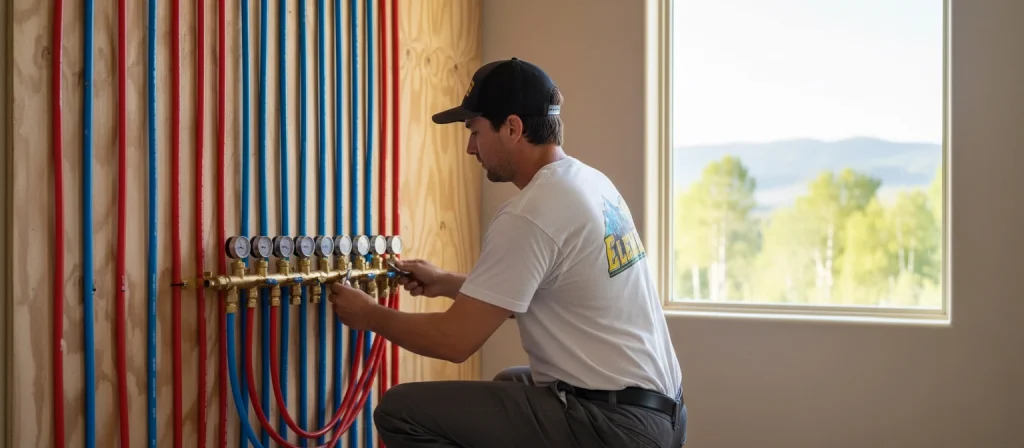
Most problems we see are a zone that won’t warm, air trapped in the loops, a tired circulator pump or controls that fight each other. We design new systems, add zones, rebalance and bleed old ones, and replace pumps, valves and manifolds. Radiant and hydronic work is offered by our Durango & Southwest Colorado team, which also handles the boilers that feed these systems.
Symptom Check
Hydronic systems are quiet when healthy, so new sounds and cold spots matter.
Often a stuck zone valve, a failed pump or air blocking the loop.
Trapped air that needs to be purged from the lines.
Warm in one room, cool in the next, on the same thermostat.
Rooms take far longer than they used to after a setback.
Moisture at a manifold, valve or baseboard joint.
A driveway loop that leaves ice behind after a storm.
What We Do
New systems, additions to old ones and repairs to everything in between.
How It Works
Square footage, new build or retrofit, floor type, the number of zones and whether the boiler needs upsizing decide the price. Whether it’s one cold room or a new home, we start with how the water flows.
We map zones, pumps and valves and find where flow is lost.
Heat loss worked out room by room for new or added zones.
Layout, equipment and price set out before work starts.
Air bled out, flow balanced and every zone tested warm.
Frozen lines in Jackson and Flagstaff, hard water in St. George, high-altitude heaters in Durango — we know your climate.
Real offices and crews in St. George, Hurricane, Durango, Jackson and Flagstaff — not a call center.
Voted Best of Southern Utah Gold in 2025 and 2026, and Best of Iron County 2025.
Burst pipe at 2 a.m. or no heat on a Sunday — a real technician answers the call.
Our Durango team services radiant and baseboard systems, and answers no-heat calls 24/7.
Maintenance Membership
Seasonal checkups for every system in your home.
Seasonal checkups catch small problems before they become emergencies — and keep your systems running efficiently all year.
For many mountain homes, yes. Radiant heat warms people and surfaces directly, so rooms often feel comfortable at a lower thermostat setting. It’s silent, doesn’t stir up dust, and works well under tile, stone and engineered wood. The tradeoff is a higher install cost and slower response than forced air.
Often. Remodels, bathrooms and additions are good places to add a zone, especially when the floor is coming up anyway. We check whether your current boiler has capacity to spare or whether the project calls for a new one; see boiler service and replacement.
Air enters when a system is drained, topped up with fresh water or has a small leak. It collects at high points and blocks flow, which shows up as gurgling and cold baseboards. Purging the loops usually fixes it, but air that keeps coming back points to a leak or a failed air separator.
Tubing set in the concrete or under pavers carries warm water and antifreeze from the boiler. A sensor starts the system when snow or ice is detected and shuts it off when the surface is clear. It needs a boiler with enough capacity, so we size the two together. Talk to our Durango team about adding one.
Hydronic and radiant work is done by our Durango location, serving La Plata and Archuleta counties. If you want one compact unit for both heat and hot water, read about tankless combi boilers.
Nationally, hydronic radiant floor heat often runs about $6 to $20 per square foot installed. New construction and additions sit at the low end; retrofitting under an existing finished floor sits at the high end, and a boiler upgrade or a snowmelt loop adds to the total. Those are national ranges that vary by home. Element gives a written, upfront price for your home after a room-by-room heat-loss calculation, and financing is available.