Built for mountain & desert homes
Frozen lines in Jackson and Flagstaff, hard water in St. George, high-altitude heaters in Durango — we know your climate.

Water Softeners
All four regions we serve have hard water, and in Southern Utah it’s very hard. The calcium and magnesium you can’t see in a glass show up everywhere else: white crust on faucets and shower glass, spots on dishes, soap that won’t lather, and a layer of scale inside your water heater that makes it work harder every year. Pipes, valves and appliances wear out sooner for the same reason.
The water softener vs water filter question comes up on most first visits. A softener removes hardness minerals; a filter removes sediment, chlorine, taste and odor; many homes end up with both. A whole-home softener removes those minerals where water enters the house. Most use ion exchange: resin beads trade hardness minerals for sodium or potassium, then rinse themselves clean with brine on a schedule. We test your water first, size the unit to your hardness and household, install it with a bypass for easy service, and set it up so it doesn’t waste salt or water. We also repair and service existing softeners.
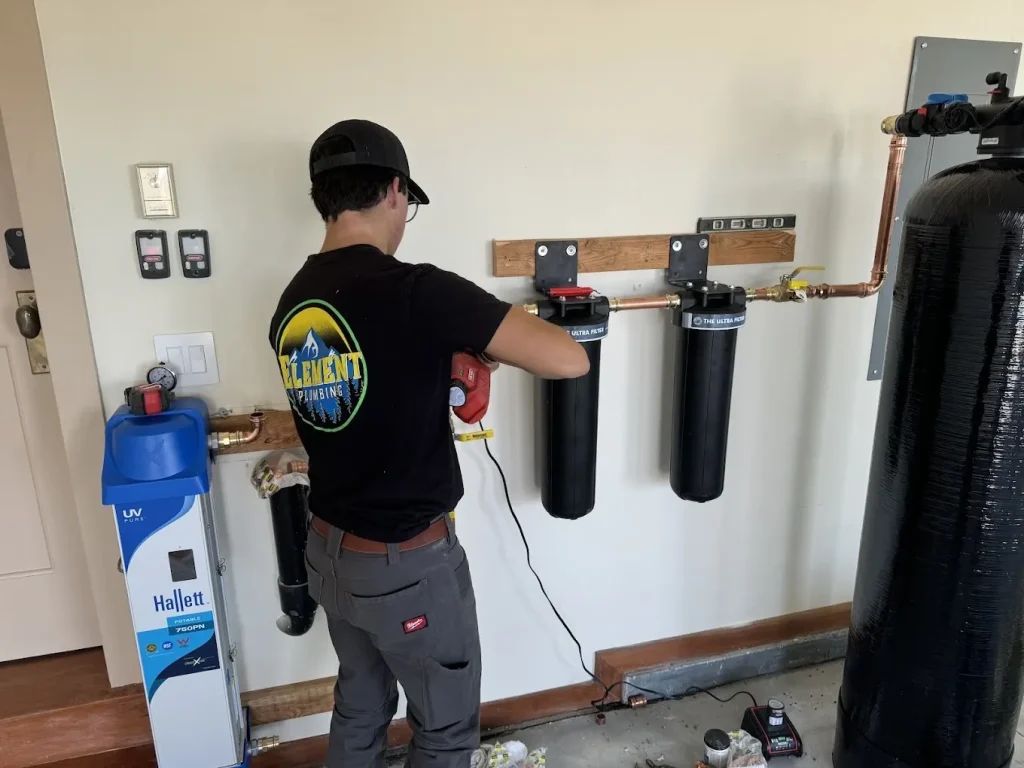
Signs of Hard Water
If several of these sound familiar, a softener is worth a conversation.
White or chalky buildup on faucets, showerheads and around drains.
Cloudy glasses and film on shower doors, even right after cleaning.
You use more shampoo and detergent and still feel residue.
Popping or rumbling as scale and sediment build up in the tank.
Scale narrowing showerheads, aerators and older supply pipe.
You already have one, but the spots and crust are coming back.
What We Do
New systems, tired systems and everything in between.
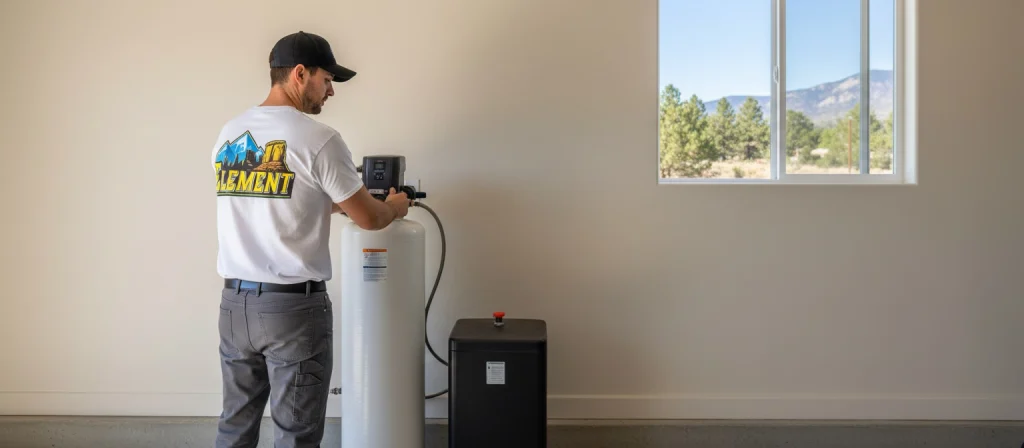
How It Works
You’ll know exactly what you’re getting and why.
We check hardness and note anything else that may need filtering.
You get a size and type that fits your home, priced before installation.
The softener is plumbed in with a bypass, a drain line and fresh settings.
We retest after setup and show you how to keep the salt topped up.
Frozen lines in Jackson and Flagstaff, hard water in St. George, high-altitude heaters in Durango — we know your climate.
Real offices and crews in St. George, Hurricane, Durango, Jackson and Flagstaff — not a call center.
Voted Best of Southern Utah Gold in 2025 and 2026, and Best of Iron County 2025.
Burst pipe at 2 a.m. or no heat on a Sunday — a real technician answers the call.
Book a water test with your local Element team, and ask about financing for a new softener.
Maintenance Membership
Seasonal checkups for every system in your home.
Seasonal checkups catch small problems before they become emergencies — and keep your systems running efficiently all year.
Yes. Each market installs and services softeners: Flagstaff, Durango, St. George and Hurricane, and Jackson. Your local page covers the water in your area and what our team there recommends. If you’re not sure how hard your water is, a quick test settles it.
A little, at first. Without hardness minerals, soap rinses off differently, and many people notice a smooth feel on their skin. That’s the absence of soap residue, not leftover soap. Most households get used to it within a week or two and find they use less soap and detergent.
Yes. Salt-free conditioners don’t remove hardness minerals; they change them so they’re less likely to stick as scale. They need less upkeep and add no sodium, but they don’t deliver true soft water. We’ll explain both after testing your water and let you choose.
It helps a great deal. Scale settles in the bottom of tank heaters and coats the heat exchangers in tankless units, which costs efficiency and shortens their life. Soft water slows that buildup. If your heater is already full of sediment, our water heater flush and safety check is a good place to start.
Keep the brine tank stocked with salt and check it every month or so for a hard crust, called a salt bridge, that stops the unit regenerating. Beyond that, an occasional service visit to check settings and the resin keeps it working well. If the spots come back, call us before the scale does.
It depends on what the test finds. Hardness (scale, spots, soap that won’t lather) is a softener problem; a filter won’t touch it. Sediment, chlorine taste, odor or a specific contaminant is a filtration problem; a softener won’t touch that. Homes with very hard city water often need only a softener. Homes on wells, or anyone who wants better drinking water at the tap, usually pair a softener with filtration or reverse osmosis.
Nationally, a whole-home softener often runs about $1,000 to $3,500 installed, with larger-capacity and dual-tank systems at the high end. Where the unit goes, whether a drain and power are nearby, and how hard your water is all move the number. Those are national ranges that vary by home. Element gives a written, upfront price for your home after the hardness test, and financing is available.